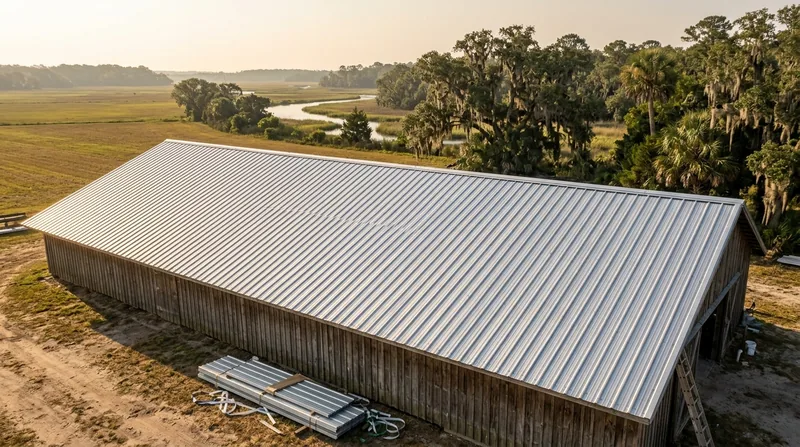




Commercial & Agricultural Metal Roofing in Charleston: Built for Barns, Shops and Lowcountry Weather
Charleston sits on a low-lying peninsula between the Ashley and Cooper rivers, wrapped in tidal marsh and live oaks, and the commercial and agricultural buildings out here take a beating that inland roofs never see. Salt air eats fasteners, afternoon thunderstorms dump two inches in an hour, and hurricane-season wind peels back anything that wasn't screwed down right. Commercial & Agricultural Metal Roofing in Charleston means panel systems sized for barns, workshops, churches, carports, marina buildings and light commercial shops, from Johns Island farm buildings to North Charleston warehouse space. We install salt-resistant panels, insulation and trim built for this climate, and we repair what other crews got wrong. If you need the residential side, start with our metal roof installation page. For commercial and ag work, call (843) 804-4445 and we will walk the building.
Why Commercial and Agricultural Metal Roofing Matters on the Charleston Peninsula and Sea Islands
Most commercial and ag buildings around Charleston are low-slope or open-framed, and that changes the failure mode. On a barn in Ravenel or a shop building off Rivers Avenue, the roof is usually exposed-fastener corrugated or ribbed panel, and the screws are the first thing to go. Salt air corrodes the washers, thermal movement wallows out the holes, and the next nor'easter pushes water sideways under the panel laps. Standing seam solves most of that, but only if the clips and flashing are detailed for wind-driven rain.
- Salt-air corrosion attacks fasteners and cut edges first, especially on buildings within a few miles of the harbor or the beach.
- Hurricane-season wind uplift tests every panel lap and edge flashing, and under-driven screws fail before the panel does.
- Afternoon thunderstorm rain finds every failed sealant joint and every clogged gutter on a big roof.
- Thermal movement on long agricultural panels works screws loose year after year until the roof is a sieve.
- Tree debris from live oaks and loblolly pines packs valleys and gutter runs and holds moisture against the metal.
We see all five on the same building more often than not, and we fix them in the right order so the repair actually holds.
Key info: A marina storage building on Johns Island had screws backing out along the entire west slope after eight years of salt exposure. We replaced the fasteners with coated screws and EPDM washers, re-set the panel laps and stopped a leak that had been staining the interior for two seasons. The fix was fasteners and detail work, not a new roof.
For permit questions on commercial and ag structures, start with the City of Charleston building department, and confirm requirements with the jurisdiction that actually governs your address.
How We Approach a Commercial or Agricultural Metal Roof in Charleston
We start on the ground, not the roof. A commercial or ag building usually has equipment, animals, stored goods or tenants underneath, so the plan has to account for access, staging and what can't get wet. We measure the actual panel runs, check the structure, and figure out whether the existing roof can be recovered or has to come off. Then we write a scope you can compare against other bids, line by line.
- We inspect the roof, fasteners, flashing and structure, and photograph the problem areas.
- We measure panel runs, slope and wind exposure, and confirm the panel profile and gauge that fit the building.
- We check permit requirements with the local building department and confirm any HOA or historic review that applies.
- We stage materials and equipment to keep the building usable and protect the ground and landscaping.
- We remove or recover the old roof, install underlayment and insulation, then set panels and fasten to spec.
- We detail ridge, eave, rake, penetration and gutter flashing, then walk the roof and the interior with you before we leave.
That sequence is why our commercial and ag roofs hold up through hurricane season and why the leaks stop.
Key info: A workshop building in North Charleston had a low-slope ribbed panel roof with ponding at the north eave. We corrected the slope with a sub-purlin build-up, installed a heavier gauge panel with a proper eave detail, and added gutters sized for the roof area. The owner has not had a leak since.
We work across the metro, including the North Charleston commercial corridor, and we can stage around operating hours.
Panel Systems and Approaches We Use on Charleston Commercial and Agricultural Roofs
Not every building needs the same system, and we do not sell one profile to every customer. A hay barn in Ravenel and a retail shop in Mount Pleasant have different priorities on cost, appearance, insulation and wind rating. Here is how the main approaches compare on the buildings we see around Charleston.
| Approach | Description | Best for |
|---|---|---|
| Exposed-fastener corrugated or ribbed panel | Screw-down panels with washers, economical and fast to install, with fasteners that need periodic replacement in salt air. | Barns, sheds, carports and budget-driven agricultural buildings. |
| Standing seam | Concealed-clip panels with raised seams, no exposed fasteners, strong wind and water performance. | Light commercial shops, churches, marina buildings and any roof where leaks and looks matter. |
| Insulated panel systems | Metal panels bonded to rigid insulation, cutting heat gain and condensation on large roofs. | Workshops, cold storage, kennels and buildings with animals or equipment underneath. |
| Recover over existing metal | New panels and underlayment installed over a sound existing metal roof, saving tear-off cost and downtime. | Commercial buildings where the existing roof deck is sound and code allows the added layer. |
| Repair and re-fastening | Screw replacement, lap re-sealing, flashing repair and panel patching on a roof that still has life in it. | Older agricultural and commercial roofs with isolated leaks and loose fasteners. |
We will tell you which approach fits your building and your budget, and we will not push a standing seam roof onto a hay barn that does not need it.
Commercial & Agricultural Metal Roofing Cost in Charleston: What to Expect
Commercial and agricultural metal roofing in Charleston is priced by the square (100 square feet), by the panel profile and gauge, and by how much detail work the building needs. Every job starts with a free estimate, because a number over the phone on a commercial building is a guess. Expect the price to move most on panel type, roof size and pitch, insulation, and how much flashing and penetration work is involved.
- Panel profile and gauge drive the material cost, with standing seam running higher than exposed-fastener panel.
- Roof size and slope set the labor hours and the equipment needed to get panels up safely.
- Insulation and condensation control add cost but protect the building and its contents.
- Access and staging on a tight commercial lot or a working farm slow the job and add labor.
- Tear-off versus recover changes the disposal and labor line more than anything else.
Get two or three estimates on the same written scope, and compare line by line rather than by the bottom number. Our full pricing overview lays out how we build a number.
Commercial & Agricultural Metal Roofing Near Me: How to Choose a Contractor Near Charleston
Hiring for a commercial or ag roof is a different decision than hiring for a house, because the building usually has to stay in service and the stakes on a bad install are higher. Ask the same questions of every bidder and compare the answers, not the sales pitch. A contractor who cannot answer these plainly is not the one you want on a barn or a shop roof.
- Confirm the contractor is licensed and insured, and ask for a certificate of insurance before work starts.
- Get two or three written estimates on the same scope so you are comparing like with like.
- Ask for references on commercial or agricultural buildings, not just houses, and call them.
- Confirm who pulls the permit and who handles inspection, because requirements vary by jurisdiction.
- Ask how they will protect the building, the equipment and the ground during the job.
If a bidder dodges any of those, move on. When you are ready to talk, our contact page gets you a free estimate and a straight answer.
Call Charleston Metal Roofing at (843) 804-4445 for commercial and agricultural metal roofing across Charleston and the Lowcountry.
Commercial & Agricultural Metal Roofing in Charleston: Pricing Guide
| Service | Price | Details |
|---|---|---|
| Roof inspection and written scope | Free estimate | On-site inspection, photos and a written scope so you can compare bids line by line. |
| Exposed-fastener panel repair and re-fastening | Starting at $450 | Screw replacement, lap re-sealing and flashing repair on smaller agricultural and shop roofs. |
| Standing seam or insulated panel installation | On estimate | Priced by square, panel gauge, insulation and flashing detail after an on-site measurement. |
| Recover over existing metal roof | On estimate | Depends on deck condition, code allowance for the added layer and panel profile selected. |
| Travel | Included | In Charleston and surrounding areas, no separate call-out or mileage fee. |
| Estimate | Free | Response within 24h at (843) 804-4445, no obligation to book. |
Indicative pricing, the exact cost depends on square footage, finish, and site access. Free personalized estimate within 24h at (843) 804-4445.


